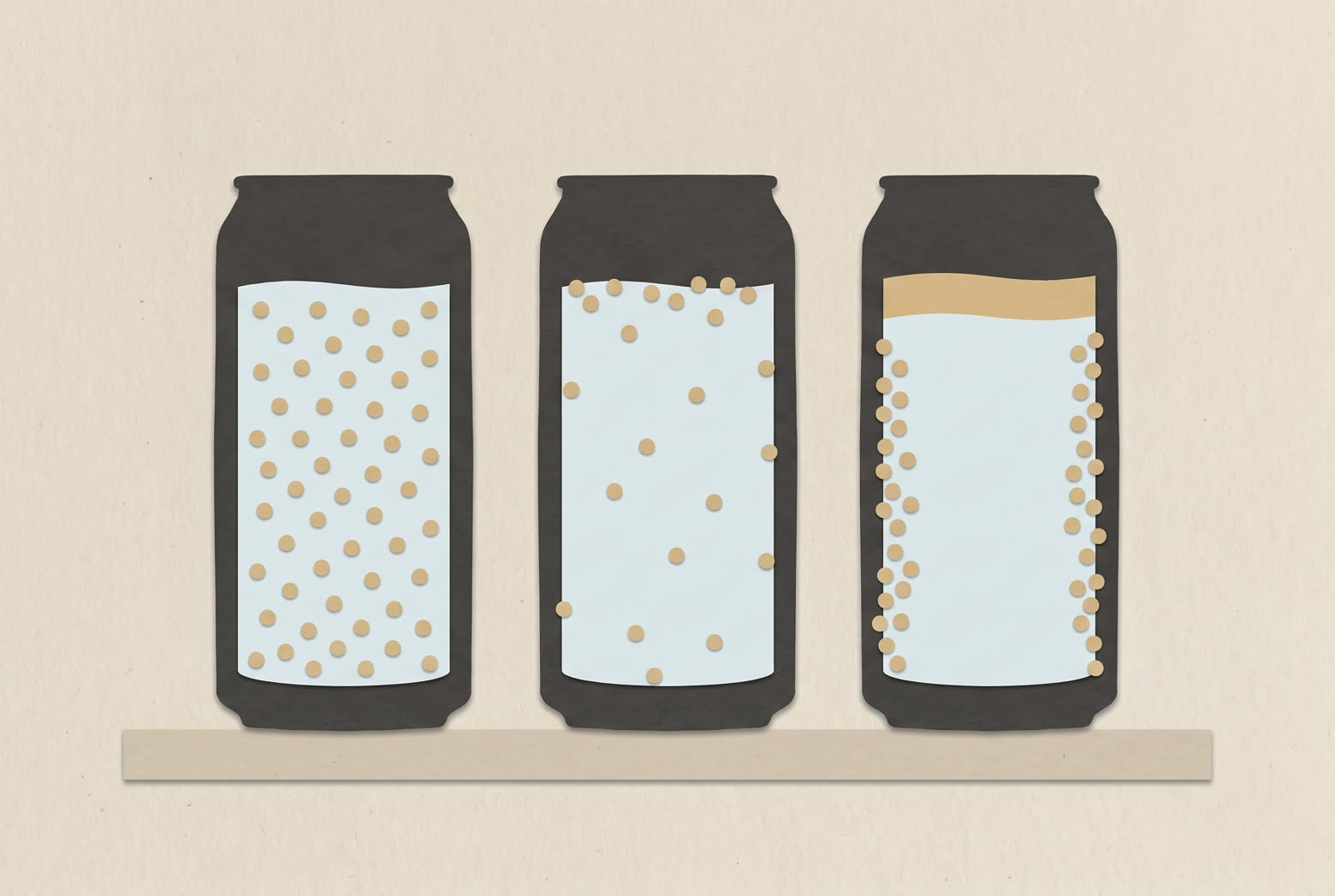
Potency loss in infused beverages is rarely a lab error. It is the cannabinoid leaving the liquid in one of a few predictable ways.
Scalping is the first. Many can liners and closures are made of polymers that oily molecules like. Cannabinoid droplets that touch the liner can be absorbed into it, and once there they do not come back. The drink tests lower, and the missing amount is in the packaging.
Creaming is the second. Droplets that are larger than their neighbours rise. Over weeks, potency concentrates near the top of the container, so the first pour is strong and the last is weak, and a sample drawn from the middle reads low.
Flocculation and coalescence are the third and fourth. Droplets that are not held apart form loose clusters, and clusters merge into bigger droplets. Bigger droplets cream faster and scalp faster, so the process feeds itself.
Ostwald ripening is the slow one. Small droplets shrink as large ones grow, until the size distribution has drifted far from where it started.
Every one of these begins with droplets that are too large, too varied in size, or not held apart strongly enough for the base they are in. That is why an emulsion that performs in still water can fail in a citrus seltzer. The fix is not more cannabinoid. It is an emulsion designed for the conditions the drink will actually see.